
Telekom Innovation Laboratories
Winterfeldtstr. 21, 10781 Berlin
jkim@net.t-labs.tu-berlin.de
+49 30 8353 58158

LISP Cache Emulator
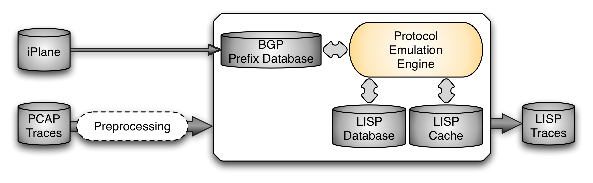
The LISP Cache emulator is software that is able to emulate the tasks of LISP xTRs and that is essentially designed to be fed with packet-level Internet traffic. Therefore, like a real LISP router, the emulator needs two data stores, namely the LISP Database and the LISP Cache.
The LISP Database is a manually configured list of internal network prefixes (EIDs), while the LISP Cache stores EID-to-RLOC mapping when there is a request for it and removes it according to the preconfigured expiration rule.
The emulator uses a local BGP prefixes database fed with the list of BGP prefixes published by the iPlane Project. This BGP prefixes database is used to group EID-to-RLOCs mappings with the granularity of existing BGP prefixes.
Instruction
- Install Perl and Net::Patricia module on your Linux system
- Install ipsumdump
- Add internal network prefixes in config-prefixes.txt
- Modify file permission: chmod +x lispcache-emulator.pl
- Try this: cat your_traces.pcap | ipsumdump -t -s -d -S -D -p -l -F --payload -q | ./lispcache-emulator.pl -m text -t 60 -g 60 -y no -q no -u 0 -h no
Download
Related Publications
-
Caching Locator/ID mappings: An experimental scalability analysis and its implications Juhoon Kim, Luigi Iannone, Anja Feldmann, Elsevier Computer Networks Journal, 2013
-
A Local Approach to Fast Failure Recovery of LISP Ingress Tunnel Routers Damien Saucez, Juhoon Kim, Luigi Iannone, Olivier Bonaventure, Clarence Filsfils, In Proceedings of the 11th IFIP International Conference on Networking. Springer, 2012
-
A Deep Dive into the LISP Cache and What ISPs Should Know about It Juhoon Kim, Luigi Iannone, Anja Feldmann, In Proceedings of the 10th IFIP International Conference on Networking. Springer, 267-278, 2011
Last update: 2016-09-19